GLP-1 weight-loss medicines copy the action of hormones your gut releases when you eat. They reduce hunger, help you feel full sooner and slow the rate at which your stomach empties, so most people eat less without the constant pull of appetite. Some newer medicines act on a second hormone, GIP, as well as GLP-1.
This topic is also in our free guide, The Weight-Loss Medication Guide. Get it emailed to you
The hormones behind appetite
When food reaches your gut, your body releases hormones that signal to the pancreas and brain that a meal is under way. Glucagon-like peptide-1 (GLP-1) is one of them. Glucose-dependent insulinotropic polypeptide (GIP) is another; healthdirect describes it as a hormone that helps control appetite and blood sugar (healthdirect).
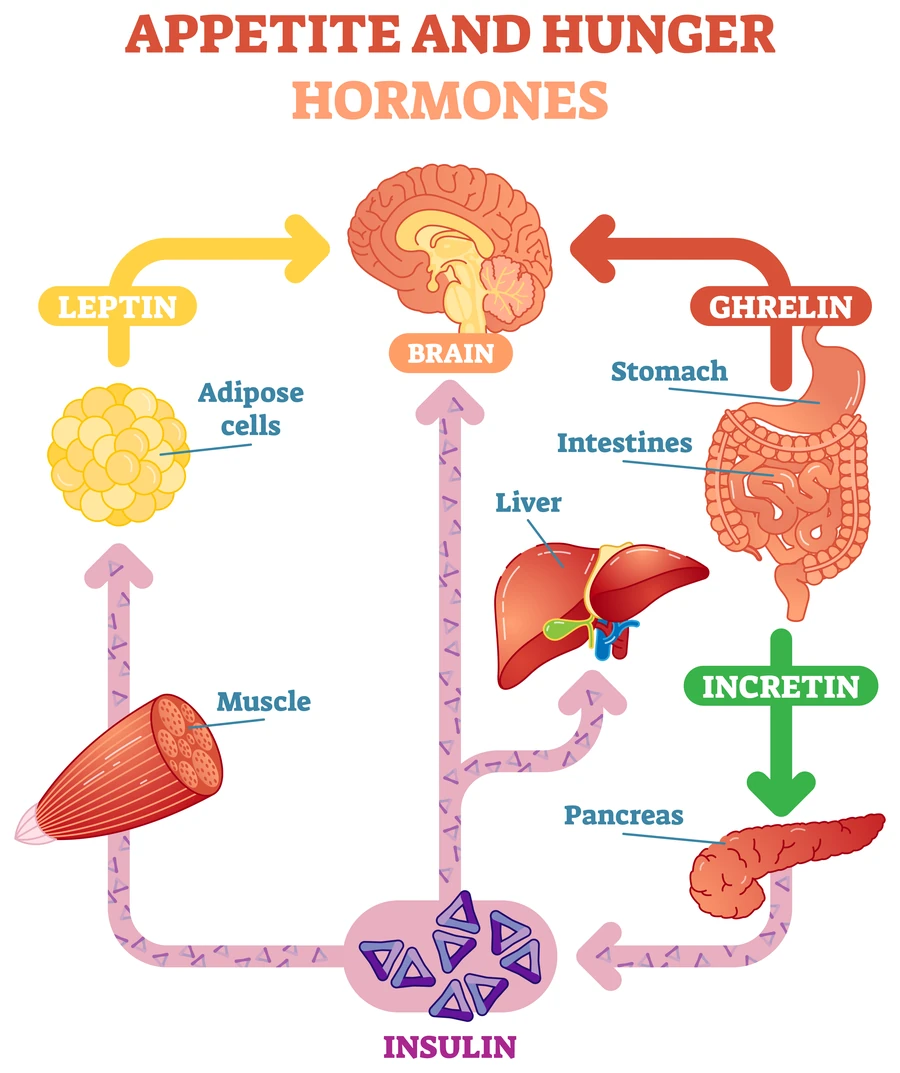
The medicines are manufactured versions of these signals, designed to keep working between doses. The two injectable products approved for weight management in Australia are each given once a week (RACGP newsGP; Wegovy CMI).
What the medicines do
According to healthdirect, GLP-1 medicines act in a similar way to the hormones released when you eat. They increase the amount of insulin made by the pancreas, which helps you feel less hungry, and they slow down how fast your stomach digests food, which can keep you feeling fuller for longer (healthdirect).
Appetite
The practical effect most people notice is a quieter appetite: smaller portions are satisfying, and the urge to keep eating between meals is reduced. This is the main way the medicines lead to weight loss. They lower how much you eat; they do not burn fat directly.
Gastric emptying
Slower stomach emptying is more than a comfort effect. A 2025 Australian clinical guideline from the Australian Diabetes Society, the Australian and New Zealand College of Anaesthetists and others reports that GLP-1 medicines have been shown to profoundly slow gastric emptying, with both short-term and ongoing use (Hocking et al. 2025). That is why food can remain in the stomach longer than expected, and why the medicines matter if you are having an anaesthetic. See weight-loss injections and surgery.
Single and dual agonists
An “agonist” is a medicine that switches on a receptor. The two injectable medicines approved for weight management in Australia differ in which receptors they target:
- Semaglutide (Wegovy for weight management) is a GLP-1 receptor agonist. It acts on GLP-1 receptors only.
- Tirzepatide (Mounjaro) is a dual agonist. healthdirect describes it as acting on two natural hormones, GLP-1 and GIP (healthdirect).
Medicines in development target further hormone combinations, including glucagon and amylin, and some are taken as a daily tablet rather than an injection. These are covered on new weight-loss medicines.
How much weight did people lose in the trials?
Clinical trials give a sense of the average effect, alongside diet and activity advice:
- In the STEP 1 trial (1,961 adults, 68 weeks), people on semaglutide lost an average of 14.9% of body weight, compared with 2.4% on placebo (ACC summary of Wilding et al., NEJM 2021).
- In the SURMOUNT-1 trial (2,539 adults, 72 weeks), people on tirzepatide lost an average of 15.0% to 20.9% depending on dose, compared with 3.1% on placebo (HCPLive summary of Jastreboff et al., NEJM 2022).
These are averages. Some people lose much more, some much less, and individual results vary. A head-to-head comparison is covered in what the SURMOUNT-5 trial found.
Why the side effects make sense
Because these medicines act on the gut, the most common side effects are gastrointestinal: nausea, vomiting, diarrhoea, constipation and stomach pain are listed in the Australian Consumer Medicine Information for both injectable products (Wegovy CMI; Mounjaro CMI). In the SURMOUNT-5 trial, these effects occurred mostly while the dose was being increased (ACC summary of Aronne et al., NEJM 2025). More detail is on side effects of weight-loss injections.
What the medicines do not do
- They do not cure obesity. healthdirect makes this point directly and stresses keeping healthy habits (healthdirect). Trial data show that much of the weight returns when treatment stops; see what happens when you stop.
- They do not replace lifestyle change. The Heart Foundation’s 2026 consensus statement says medicines should complement, not replace, behaviour change (RACGP newsGP).
- They do not select fat only. Part of the weight lost is lean tissue, including muscle. See muscle loss on weight-loss medication.
- They do not tighten skin. Faster, larger losses can leave loose skin; see weight-loss injections and your skin.
Where they fit in Australian guidance
The Australian Diabetes Society’s obesity management algorithm (January 2026) lists semaglutide and tirzepatide among six TGA-approved medicines, and sets weight-loss targets of 10–15% for people with a BMI of 30–40 and more than 15% for a BMI over 40 with complications (ADS algorithm). Whether a medicine suits you, and which one, is a decision for you and your prescribing doctor.
Where to next
- Weight-loss medication in Australia
- Side effects of weight-loss injections
- How weight loss works
- Protein and muscle
If you are still losing weight, the readiness assessment can help you track when you might be ready to consider skin surgery. If your weight has settled and loose skin is now the main issue, book a consultation with Dr Kumar.
Sources
- healthdirect: Weight loss medicine (reviewed March 2026)
- Hocking SL et al. Periprocedural use of GLP-1 and GLP-1/GIP receptor agonists. Anaesth Intensive Care 2025;53(5):300–306
- Wilding JPH et al. STEP 1. NEJM 2021;384:989–1002 (ACC summary)
- Jastreboff AM et al. SURMOUNT-1. NEJM 2022;387:205–16 (HCPLive summary)
- Aronne LJ et al. SURMOUNT-5. NEJM 2025;393(1):26–36 (ACC summary)
- Wegovy Consumer Medicine Information (July 2026)
- Mounjaro KwikPen Consumer Medicine Information (September 2026)
- RACGP newsGP: Heart Foundation consensus statement on obesity and CVD (May 2026)
- Australian Diabetes Society: Australian Obesity Management Algorithm (January 2026)