Yes, some of the weight lost on GLP-1 medicines is lean tissue, which includes muscle. In the body-composition substudy of the SURMOUNT-1 trial, about three-quarters of the weight lost was fat and about one-quarter was lean mass, the same proportion seen in people losing weight on placebo (Look et al., Diabetes Obes Metab 2025). Resistance training and adequate protein are the two measures most consistently recommended to reduce it.
This topic is also in our free guide, The Weight-Loss Medication Guide. Get it emailed to you
A note on the medicine names
Ozempic and Wegovy both contain semaglutide. In Australia, Ozempic is approved for type 2 diabetes only; Wegovy is the semaglutide product approved for weight management (healthdirect). The semaglutide data on this page come from the STEP 1 trial, which studied the weight-management dose. Mounjaro contains tirzepatide, studied in SURMOUNT-1.
What a DEXA scan measures
DEXA (also written DXA) is a low-dose X-ray scan best known for measuring bone density (healthdirect). A body-composition report from the same scan splits your weight into fat, lean mass and bone, region by region.
One caveat matters when reading the studies below: DEXA “lean mass” is not the same as muscle. It also includes water, glycogen, organs and other non-fat tissue (Barbell Medicine). Some lean-mass loss during weight loss is expected and is not all muscle.
What the STEP 1 DEXA substudy showed (semaglutide)
A subgroup of 140 STEP 1 participants had DEXA scans over 68 weeks (Wilding et al., ABCD 2021). On semaglutide:
- total fat mass fell by 19.3%
- total lean mass fell by 9.7%
- visceral fat, the fat around the internal organs, fell by 27.4%
- lean mass as a proportion of total body mass rose by 3.0 percentage points
Put simply, people lost both fat and lean tissue, but proportionally more fat, so their body composition improved overall.
What the SURMOUNT-1 DXA substudy showed (tirzepatide)
In SURMOUNT-1, 160 participants (124 on tirzepatide, 36 on placebo) had DXA scans over 72 weeks (Look et al., Diabetes Obes Metab 2025):
- Tirzepatide: body weight −21.3%, fat mass −33.9%, lean mass −10.9%.
- Placebo: body weight −5.3%, fat mass −8.2%, lean mass −2.6%.
- In both groups, about 75% of the weight lost was fat and about 25% was lean mass. The ratio was consistent across sex, age and amount of weight lost.
The placebo comparison is the useful part. People losing weight through diet and activity alone lost lean mass in the same proportion. The medicine produced more weight loss, and therefore more lean-mass loss in absolute terms, but did not appear to change the share of lean tissue lost. Individual results vary.
Why it matters
healthdirect notes that loss of muscle mass can cause weakness and difficulty with physical tasks, and can lead to falls and fractures (healthdirect). If you are heading towards skin surgery, muscle also matters for two practical reasons: it shapes what sits under your skin, and good nutritional status before surgery supports healing. A review of body contouring after massive weight loss gives a peri-operative protein goal of 70–100 g a day (Giordano, Open Access Surgery 2015). See nutrition before body contouring.
What reduces muscle loss
Resistance training
The Australian Diabetes Society’s obesity management algorithm (January 2026) recommends resistance exercise to protect muscle during weight loss (ADS algorithm). healthdirect suggests resistance training 3 times a week alongside aerobic exercise (healthdirect). That means working muscles against load (weights, machines, bands or body weight) on a regular schedule, progressed over time. If you are new to it, an accredited exercise physiologist can set a program around your health conditions. See keeping muscle while you lose weight.
Enough protein
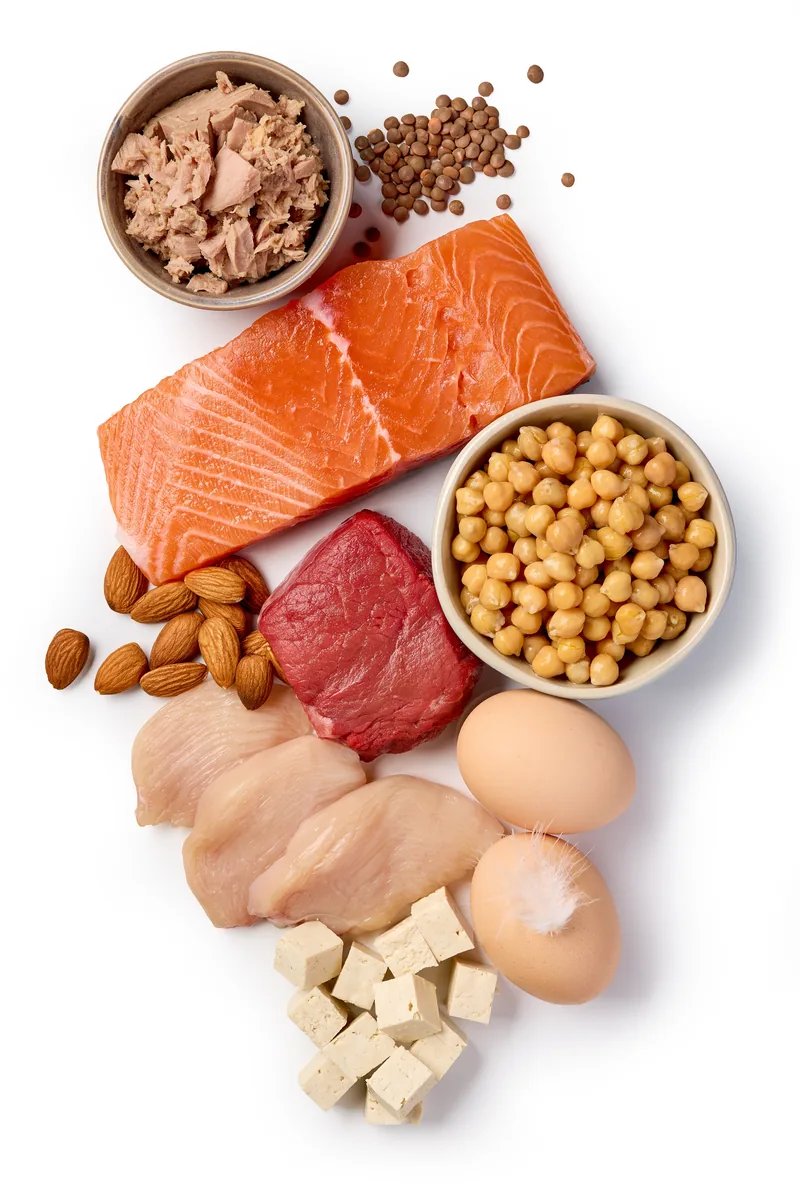
Reduced appetite makes it easy to under-eat protein without noticing. healthdirect advises a balanced diet with enough protein to help maintain muscle mass (healthdirect). How much you need depends on your size, age, activity and kidney health, which is why individual advice from a dietitian is worthwhile. See protein and muscle, or read about Dr Kumar’s dietitian, Amy Kellner APD.
Measuring rather than guessing
Scales cannot tell fat from muscle. A DEXA body-composition scan can, and repeated scans show the trend. Note that body-composition DEXA is not covered by Medicare and attracts a private fee (Macquarie Medical Imaging). Your GP can advise whether it is worthwhile for you; see health checks and investigations.
Decisions about your medicine, including dose and duration, belong with your prescribing doctor.
Where to next
- Protein and muscle
- Keeping muscle while you lose weight
- What happens when you stop weight-loss medication
- Men after major weight loss
If your weight has settled and loose skin is now the main issue, book a consultation with Dr Kumar or take the readiness assessment.
Sources
- Look M et al. Body composition changes during weight reduction with tirzepatide in the SURMOUNT-1 study. Diabetes Obes Metab 2025. doi:10.1111/dom.16275
- Wilding JPH et al. STEP 1 DEXA substudy, poster, ABCD October 2021
- healthdirect: Weight loss medicine
- healthdirect: Bone density scan
- healthdirect: Loss of muscle mass
- Barbell Medicine: GLP-1 medications and muscle loss
- Australian Diabetes Society: Australian Obesity Management Algorithm (January 2026)
- Giordano S. Open Access Surgery 2015;8:51–60
- Macquarie Medical Imaging: DEXA information sheet